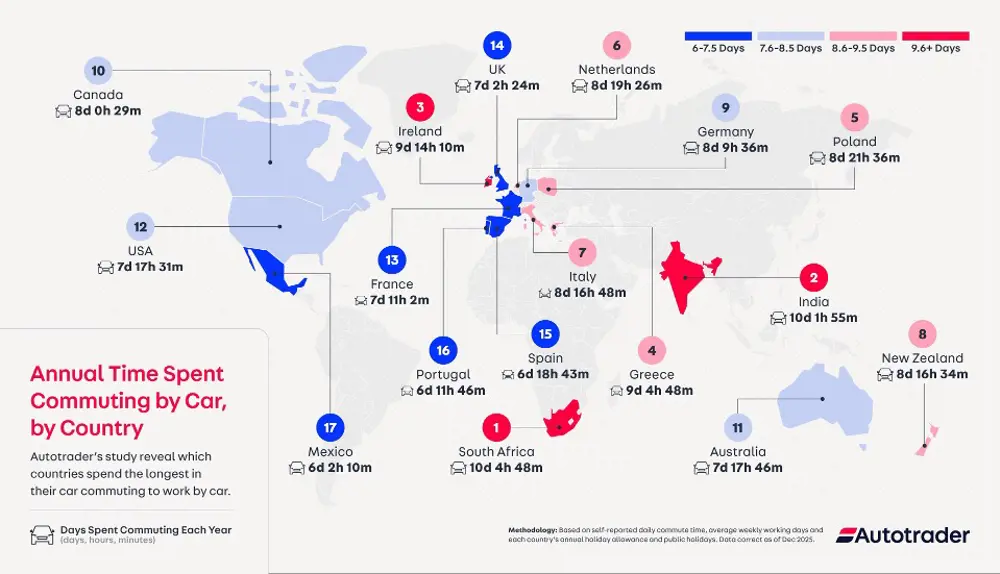
Globally, commuters clock an average of 8 days, 5 hours and 53 minutes behind the wheel each year just getting to and from work. But for some countries, the commute is a far longer journey.
Stress or sanctuary? Drivers reveal their mindset
While commuting can be a time-consuming part of the day, many drivers actually relish in the experience. In fact, over half (53%) of global drivers say they enjoy their car commute.
This is especially the case in South Africa, where 72% find the daily drive relaxing. Followed by the USA, where 57% enjoy their peaceful commute; New Zealand (55%), Germany (54%), and the Netherlands (53%) follow closely behind.
The reason for such a relaxing commute can be put down to what people spend their drive time doing.
- 82% spend their commute time listening to music, podcasts and audiobooks
- 47% enjoy some much-needed time alone
- 32% find the physical act of driving to be an enjoyable part of their day
In contrast, 34% of global commuters find their drive to work stressful, with India leading the way with over a third reporting their journey to work is not relaxing. Greece and Mexico follow closely, with 30% and 29% respectively finding the journeys to be a stressful part of their day.
In Italy (26%) and the UK (22%), stress is the overriding feeling for many commuters, with extenuating circumstances causing frustration on the roads.
What frustrates drivers the most?
Across the board, traffic congestion is the number one complaint for commuters, with 84% of drivers in agreement. These frustrations are especially high in India (94%), South Africa (92%), and Portugal (91%), where busy roads significantly extend commute times and contribute to daily stress.
Beyond gridlock, it’s driver behaviour that gets under most people’s skin. Bad driver behaviour is cited by 70% globally as a major dislike, with the highest levels of frustration coming from the UK and the Netherlands (both 76%), followed by France (74%), Germany (73%), and Canada (73%).
But in some cases, traffic and other drivers aren’t the only issue, as 51% of motorists experienced car issues in the past year that have affected their drive to work, meaning only 49% made it through 2025 with no disruption to their commute at all.
Car reliability
When it comes to reliability, drivers in the Netherlands (68%), New Zealand (66%) and the USA (63%) are the most likely to enjoy a commute free from car issues, all reporting no vehicle issues in the past year. The UK, Australia, and Germany follow close behind, each with 61% of drivers making it through 2025 with no car related disruption.
On the flip side, drivers in South Africa reported the most unreliable commutes, with a staggering 84% experiencing a car fault that impacted their journey in the past year. India (78%) and Mexico (66%) were also impacted by car faults, followed by Poland (63%) and Italy (60%).
Commuting and productivity
For 30% of commuters, the journey leaves them feeling drained, with nearly two thirds (65%) wishing they felt more productive during their commute.
Autotrader partnered with Emily Austen, productivity expert and author of SMARTER: 10 Lessons for a More Productive and Less Stressed Life who explains, “One of the biggest misconceptions about productivity is that it only counts if you’re visibly producing something.” adding “we need to match our energy to a task in order to excel.”
Austen encourages commuters to rethink how they view this time, explaining: “Planning your playlist for the morning means that you are setting an intention for your mood. You’re reducing decision-making and any issues for your commute. Reducing decision-making is productive. Protecting your mood is productive.”
“Productivity on your commute doesn't mean working, in fact the 82% of people who spend their commute time listening to music, podcasts and audiobooks are being productive already.” Austen adds.
“For those who prefer a more calm, quiet and relaxing commute with no audio distractions, “find time to be present and grateful for the current experience you are having, rather than thinking about the next twenty-four hours. If your commute is the only uninterrupted thinking space in your day, that matters and should be enjoyed.”
That said, productivity levels are already high in several regions, with South Africa leading the way with 94% of commuters reporting feeling productive while travelling to and from work, closely followed by India at 93%. Greece (77%) and Mexico (76%) also show strong productivity levels, and Italy and Portugal round out the list with 73% of commuters in these regions finding the time spent in the car valuable.
Time for an upgrade
According to drivers, when asked what could improve their commute, 65% believe a newer or different car would improve enjoyment. In-car technology (58%) came in second, followed by more comfortable seats (50%) and better fuel efficiency (49%).